How to Count Macros
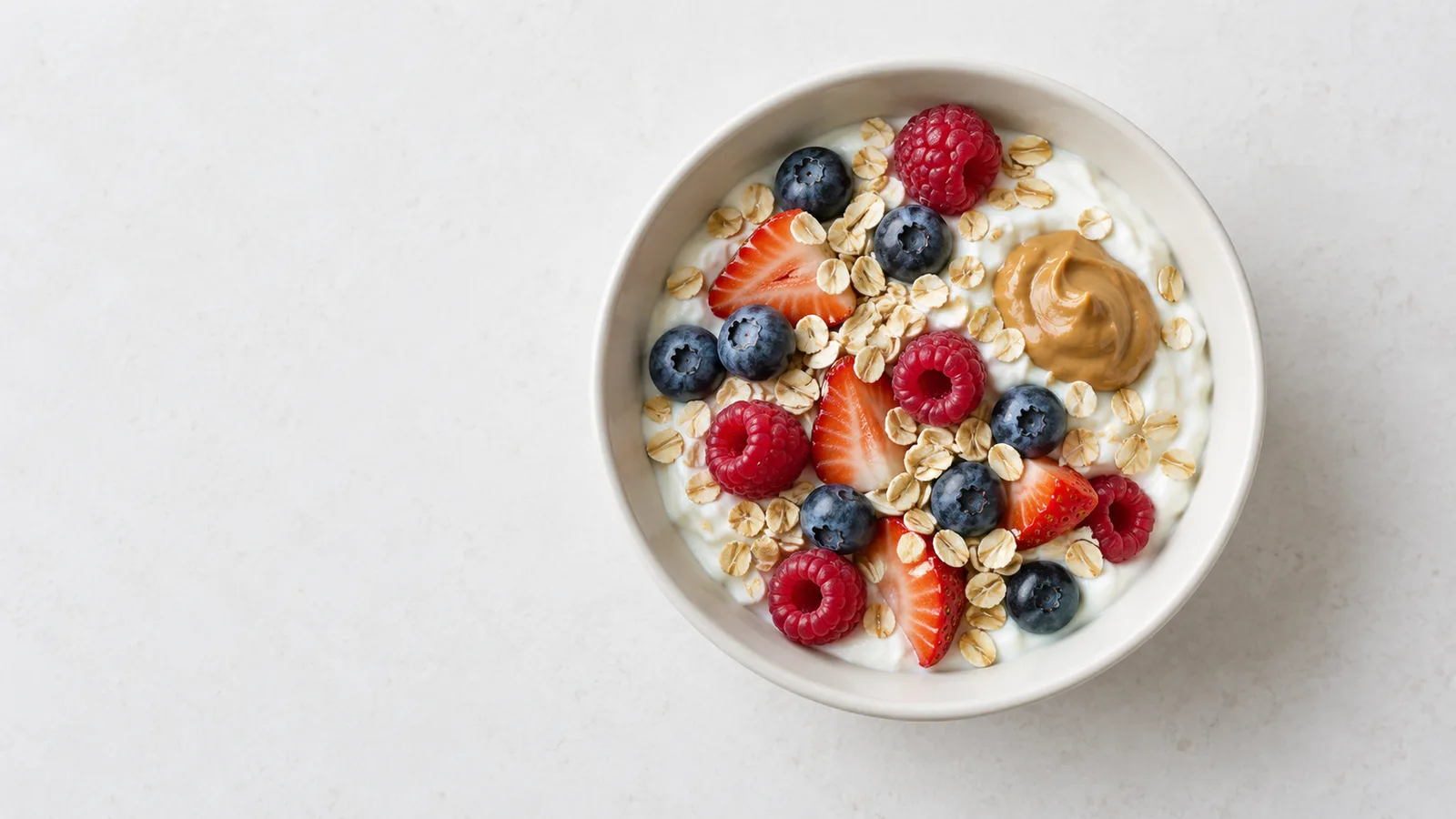
Macros are protein, carbohydrates and fat, the nutrients that supply energy in food. Counting macros means setting daily targets in grams, then logging what you eat against them.
For someone starting out, a calorie target plus three macro targets can feel like four separate problems. The numbers are connected: protein, carbohydrates and fat make up your calorie total.
Start with your calorie target, set protein in grams, choose a fat target and give the remaining calories to carbohydrates. Then log your meals with food labels or a food database. You do not need to hit every gram exactly.
The macro calculator gives you starting targets. The steps below explain what the numbers mean and how to use them with ordinary foods.
What macros are and how their calories add up
For a basic macro calculation, protein and carbohydrates each provide 4 kcal per gram and fat provides 9. These are the general energy factors used in U.S. food labeling [1].
| Macro | Energy |
|---|---|
| Protein | 4 kcal per gram |
| Carbohydrates | 4 kcal per gram |
| Fat | 9 kcal per gram |
That gives the planning formula:
Calories from macros = protein grams × 4 + carbohydrate grams × 4 + fat grams × 9
Macro calories are part of your calorie total, not something to add on top of it. The calories per gram calculator lets you check the conversion. Food labels may not match the formula exactly, for reasons explained below.
For weight loss, start with calories
There is no single macro ratio everyone needs for weight loss.
In a trial with 811 adults with overweight or obesity, researchers compared four reduced-calorie diets with different shares of fat, protein and carbohydrates. After two years, weight loss was similar across the comparisons [2].
The DIETFITS trial assigned 609 adults to a healthy low-fat or a healthy low-carbohydrate diet. After 12 months, there was no statistically significant difference in weight change. Participants were not given calorie targets [3].
The practical point is to put your calorie target ahead of searching for an ideal ratio. Set protein, then let fat and carbohydrates fit your meals.
For adults aged 19 and older, the Institute of Medicine gives broad ranges: protein 10% to 35%, fat 20% to 35% and carbohydrates 45% to 65% of calories. These are reference ranges, not a weight-loss formula [4].
How to calculate your macros in four steps
1. Get your calorie target
Use the macro calculator to get a starting calorie target for your goal. The TDEE calculator shows your estimated daily energy use.
TDEE, total daily energy expenditure, is the energy your body uses across the day. A maintenance estimate and a weight-loss target are different numbers. For the steps below, use the target for your goal, not the maintenance estimate.
Treat the result as a starting estimate. The macro steps divide your calorie target; they do not tell you whether the target itself suits you.
2. Set protein in grams
Use the protein calculator for a starting daily protein target.
For weight loss, it uses 1.6 g per kilogram of your weight or of the weight at a BMI of 30, whichever is lower, and keeps protein between 10% and 35% of calories (at most 30% at age 18). For maintaining it uses 1.4 g per kilogram and for gaining 2.0 g. These are calculator and app defaults. For more on choosing a target, read how much protein you need a day.
Multiply the protein grams by 4 to see how much of your calorie target protein uses.
3. Set fat
The default calculation gives fat 25% of calories, which sits inside the adult range of 20% to 35% [4].
Fat grams = calorie target × 0.25 ÷ 9
This is a starting share. Meals do not all need the same amount of fat.
4. Give the remaining calories to carbohydrates
Subtract the calories from protein and fat, then divide what is left by 4:
Carbohydrate grams = (calorie target − protein grams × 4 − fat grams × 9) ÷ 4
If you round the fat target to whole grams, use the rounded number here so the total stays consistent. The macro calculator does all four steps for you.
A worked example: 2,000 kcal and 120 g protein
Suppose your daily calorie target is 2,000 kcal and your protein target is 120 g.
- Protein: 120 × 4 = 480 kcal.
- Fat at 25% of calories: 2,000 × 0.25 ÷ 9 = 55.6 g, rounded to 56 g, which gives 56 × 9 = 504 kcal.
- Carbohydrates take the rest: (2,000 − 480 − 504) ÷ 4 = 254 g, which gives 254 × 4 = 1,016 kcal.
| Macro | Daily target (g) | Calories (kcal) |
|---|---|---|
| Protein | 120 | 480 |
| Fat | 56 | 504 |
| Carbohydrates | 254 | 1,016 |
| Total | 2,000 |
This follows the default calculation above. The example shows the arithmetic; your own starting targets may differ.
Where macros come from in everyday foods
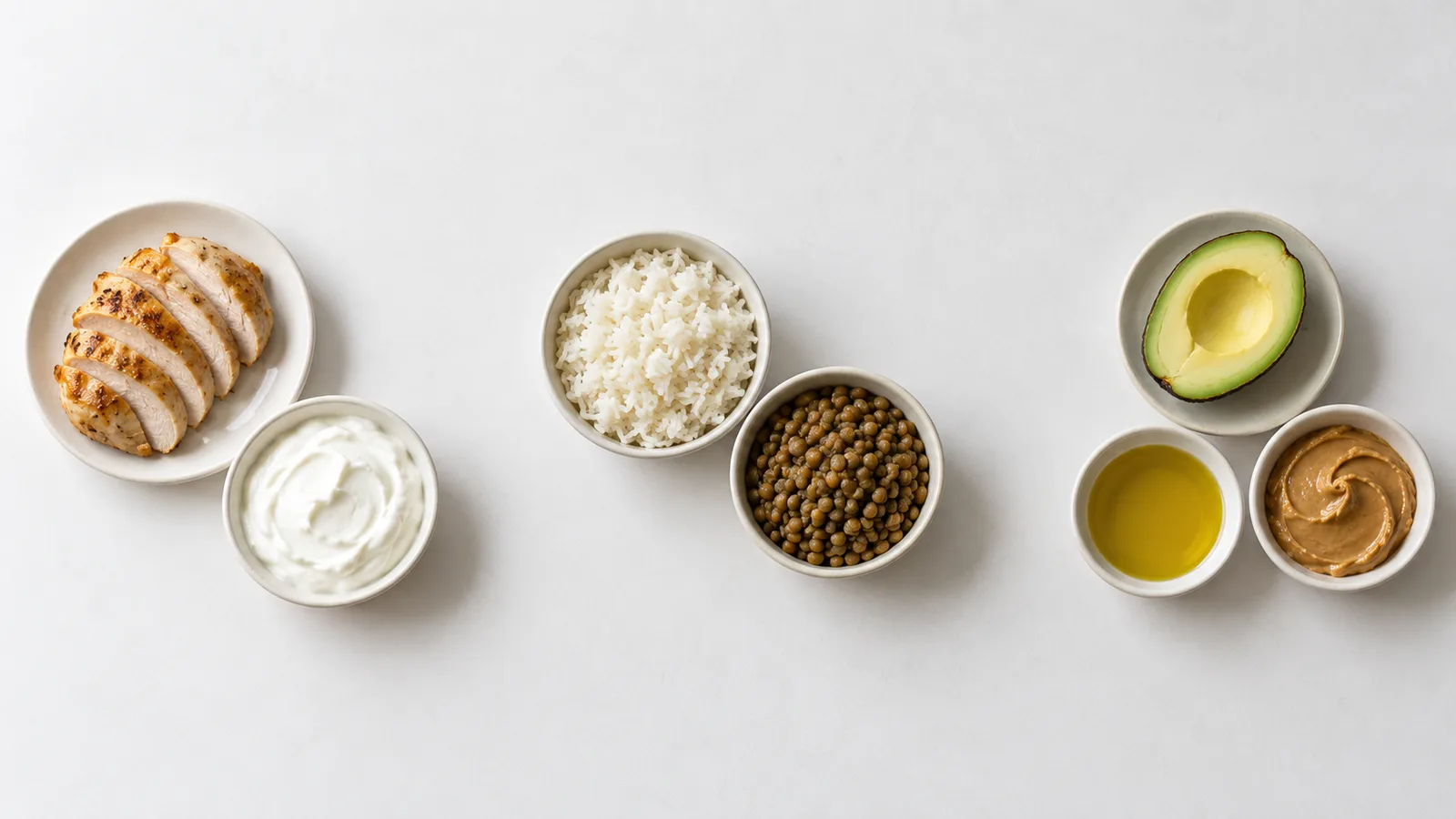
Most foods give more than one macro. A food you choose for protein can also add carbohydrates or fat. These portions use values from our food pages [5]:
| Food and portion | Calories (kcal) | Protein (g) | Carbs (g) | Fat (g) |
|---|---|---|---|---|
| Chicken breast, roasted, 4 oz (about 113 g) | 186 | 35 | 0 | 4 |
| Greek yogurt, low-fat, 150 g | 110 | 15 | 6 | 3 |
| Lentils, boiled, 1 cup (198 g) | 230 | 18 | 40 | 1 |
| White rice, cooked, 1 cup (158 g) | 205 | 4 | 45 | 0 |
| Avocado, half (100.5 g) | 161 | 2 | 9 | 15 |
| Peanut butter, 2 tbsp (32 g) | 191 | 7 | 7 | 16 |
| Olive oil, 1 tbsp (13.5 g) | 119 | 0 | 0 | 14 |
Lentils give both protein and carbohydrates. Peanut butter has protein too, but most of its calories come from fat. When you log a food, count all of its macros.
Start with meals you already eat. Log their ingredients and portions, then see what each meal adds to your targets. There is no need to swap familiar meals for foods that contain only one macro. For protein spread across ordinary meals, see how to get 100 grams of protein a day.
How to log meals and read labels
You can count macros in a notebook, a spreadsheet or an app. For each food, record the portion and its calories, protein, total carbohydrates and fat. The entries add up to your daily totals.
Match the entry to the food. Check the brand where it matters and choose raw or cooked to match what you ate. Include cooking fat and other ingredients of the meal.
Check the serving size. On U.S. Nutrition Facts labels, the amounts refer to the stated serving. Scale them to your portion, and use the grams, not the percent Daily Value [1]. The guide to reading a nutrition label shows how to scale it.
Use total carbohydrate. On U.S. labels, total carbohydrate already includes dietary fiber, which is listed beneath it. Do not add the fiber again [1]. The guide to how much fiber you need a day covers fiber as a separate target.
Log the label's calories as they are. FDA rules allow several ways to calculate calories, and labels round the numbers, so a label may not match 4-4-9 exactly [1].
How close is close enough?
Use your targets to guide meal choices, not as numbers you must reach exactly by the end of the day.
- Calories: compare your logged intake with your calorie target.
- Protein: aim for your daily target and notice meals where a protein source would help.
- Fat and carbohydrates: use your targets as a guide; daily amounts can vary.
At the end of the week, look at your average calories and whether protein was near your target on most days. Look for repeated patterns, such as a regular meal with little protein or an ingredient you often forget to log.
A weekly review shows what to adjust in your usual meals. It does not mean eating less the next day after a day above your target, or eating extra just to complete a macro number. If all three macros feel like too much, start with calories and protein and add the others when logging feels familiar.
See your macros as you log
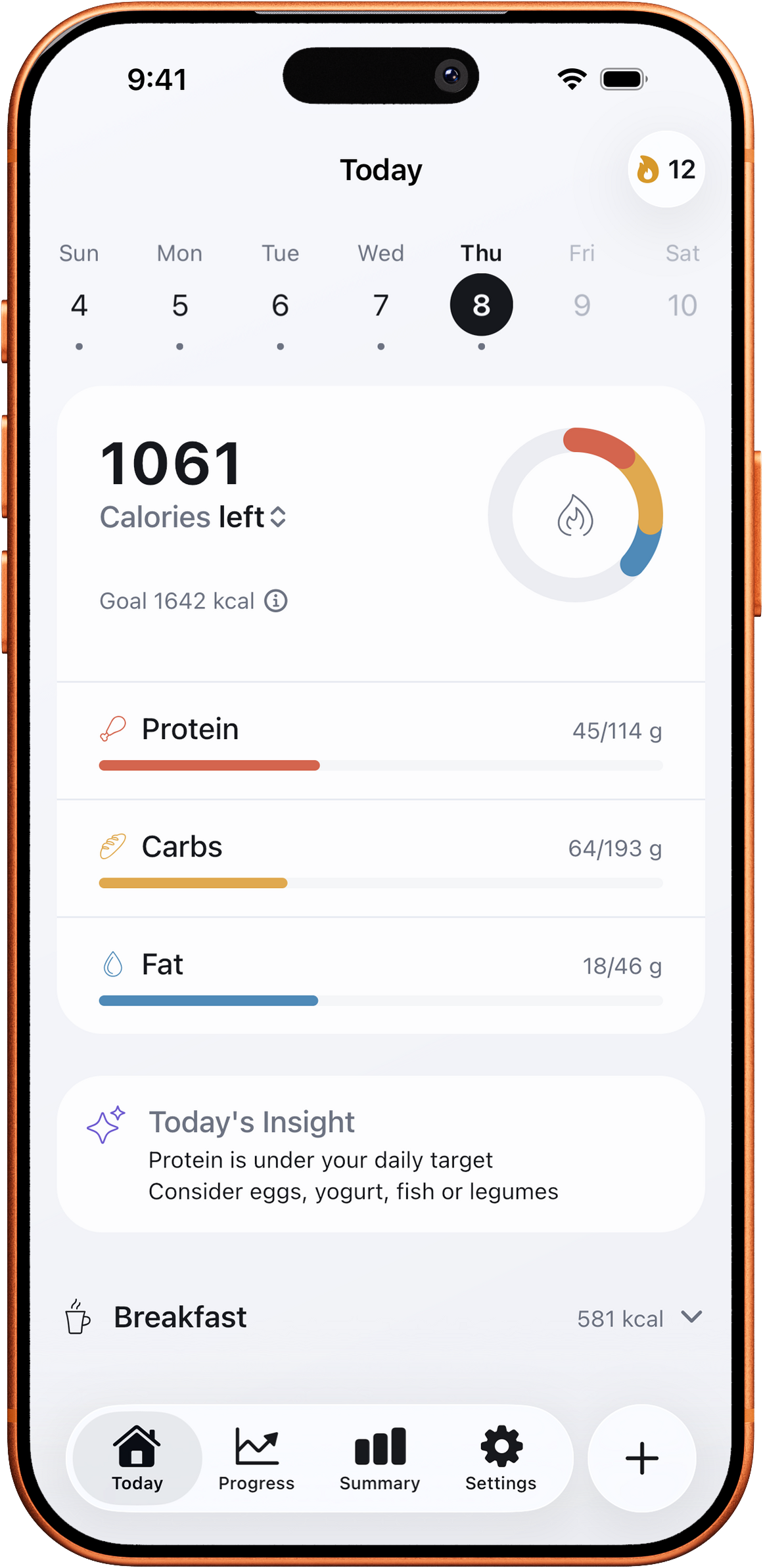
The ClariMeal Today screen shows your logged calories, protein, carbs and fat against your daily targets. You can log a meal by photo, search or barcode. A photo is sent for analysis only with your consent, and you review and correct the estimated calories and macros before logging.
See Your MacrosSee Your Macros
Sources
- U.S. Food and Drug Administration. 21 CFR 101.9, Nutrition labeling of food. law.cornell.edu ↑
- Sacks FM, Bray GA, Carey VJ, et al. Comparison of weight-loss diets with different compositions of fat, protein, and carbohydrates. New England Journal of Medicine 2009;360(9):859-873. doi.org/10.1056/NEJMoa0804748 ↑
- Gardner CD, Trepanowski JF, Del Gobbo LC, et al. Effect of low-fat vs low-carbohydrate diet on 12-month weight loss in overweight adults and the association with genotype pattern or insulin secretion: the DIETFITS randomized clinical trial. JAMA 2018;319(7):667-679. doi.org/10.1001/jama.2018.0245 ↑
- Institute of Medicine. Dietary Reference Intakes for Energy, Carbohydrate, Fiber, Fat, Fatty Acids, Cholesterol, Protein, and Amino Acids. National Academies Press, 2005. doi.org/10.17226/10490 ↑
- U.S. Department of Agriculture, Agricultural Research Service. FoodData Central. fdc.nal.usda.gov ↑