How to Read a Nutrition Label When You Count Calories
Serving size is the first line to check on a U.S. Nutrition Facts label: every calorie and nutrient amount in the per-serving column refers to that amount of food [1].
A package can look like one portion while containing several label servings. When you count calories to lose weight, that can leave you unsure whether to log the number printed on the label or multiply it.
Start with three steps:
- Check the serving size and servings per container. See what amount the numbers describe.
- Read the calories, protein, carbs and fat for that amount. Check the column heading if there is more than one.
- Scale those numbers to what you ate. Divide your amount by the label amount, then multiply.
On an EU label, start from the per-100 g or per-100 ml column. The same calculation works.
Serving size vs servings per container
Serving size is the amount one set of label values describes. Servings per container tells you how many of those amounts the package holds. The serving size reflects how much people typically eat or drink; it is not a recommendation of how much you should eat [1].
Here are selected lines from a made-up label. The figures explain the calculation; they do not describe a real product.
| Example label line | Value |
|---|---|
| Serving size | 2/3 cup (55 g) |
| Servings per container | About 8 |
| Calories per serving | 230 kcal |
| Protein | 6 g |
| Total carbohydrate | 34 g |
| Total fat | 8 g |
| Dietary fiber | 4 g |
| Total sugars | 6 g |
| Includes added sugars | 4 g |
If you eat 1 cup
One cup is one and a half of the example servings: 1 cup ÷ 2/3 cup = 1.5 servings, so 230 × 1.5 = 345 kcal. Multiply the macros by 1.5 too: 9 g protein, 51 g carbs and 12 g fat.
If you eat half the package
With about 8 servings in the package, half is about 4 servings: 230 × 4 = about 920 kcal, with about 24 g protein, 136 g carbs and 32 g fat.
The word "about" matters because the number of servings can be rounded [2]. If you know the weight you ate, use it directly: grams eaten ÷ 55 × 230.
This calculation describes your portion. It does not tell you that you should have eaten a different amount.
Why calories may not match the macro math
The usual estimate is 4 kcal per gram of protein, 4 per gram of carbohydrate and 9 per gram of fat. U.S. labels round calories and grams separately, and the permitted ways to calculate calories can treat fiber and sugar alcohols differently [2].
Calories are rounded to the nearest 5 up to 50 kcal and to the nearest 10 above 50; amounts under 5 kcal may appear as 0 [2]. The made-up macros give 6 × 4 + 34 × 4 + 8 × 9 = 232 kcal, so a label value of 230 kcal fits the rounding.
For logging, use the printed calories and scale them to your portion. You do not need to replace them with your own 4-4-9 result. The guide to how to count macros explains the calculation.
Carbs, fiber and sugars without counting them twice
On a U.S. label, total carbohydrate already includes dietary fiber and sugars; the indented lines describe parts of that total [2].
In the example, log 34 g if your diary asks for total carbohydrate. Do not add the 4 g of fiber or the 6 g of sugars to it. If your diary has a fiber field, the fiber amount can go there too. For the fiber line, see how much fiber you need a day.
Total sugars include sugars that are naturally in the food and sugars added to it. In the example, the 4 g of added sugars are already part of the 6 g total [2]. Their calories are already in the calorie figure, so do not add them again.
What does percent Daily Value mean?
Percent Daily Value (%DV) shows how much a serving gives toward a daily reference amount for one nutrient. The label uses 2,000 calories a day for general nutrition advice, not as your personal calorie target [2].
The FDA's general guide is that 5% DV or less of a nutrient per serving is low and 20% DV or more is high [1]. These words describe the nutrient, not the food as a whole.
A percentage next to fat or fiber is not the share of your daily calories. For your diary, work with the calories and grams for your portion. For a personal starting point, see how many calories to eat a day.
When the label has two columns
Some U.S. packages show values both per serving and for the whole package, for packages that people may eat at once [2]. If you eat the whole package, use that column directly; do not multiply it by the number of servings again.
Always read both headings: two columns can also show the food as packaged and as prepared [2].
How EU nutrition labels differ
On EU labels, energy and nutrients are given per 100 g or per 100 ml. Per-portion values may be added when the portion size and the number of portions are stated [3].
- Energy appears in kJ and kcal. Use the kcal figure if your diary records calories.
- Carbohydrate does not include fiber. Fiber, when shown, has its own line, so do not subtract it from the carbohydrate figure.
- The reference intake is 8,400 kJ / 2,000 kcal for an average adult. It is not a personal target [3].
For another made-up example, a label states 200 kcal per 100 g and you eat 150 g: 150 ÷ 100 = 1.5, and 200 × 1.5 = 300 kcal. Use the same multiplier for protein, carbohydrate and fat. For a drink labeled per 100 ml, use the milliliters you drank.
How to log a packaged food
Keep the package next to you while you check the entry:
- Find the food. Scan the barcode if your app offers it, or search for the matching food.
- Compare the entry with the package. Check the serving weight, the calories and whether the values describe the food dry, as sold or as prepared.
- Set the amount you ate. Choose grams, milliliters or servings, then check that the calories match your calculation.
- Log additions separately. Milk, oil or other ingredients need their own entry if the values you used do not include them.
A dry-food label and a cooked portion need matching measurements. If the difference is unclear, see whether to weigh food raw or cooked.
Once the label amount and your portion match, you have a number you can explain. Then log it.
Packaged food in ClariMeal
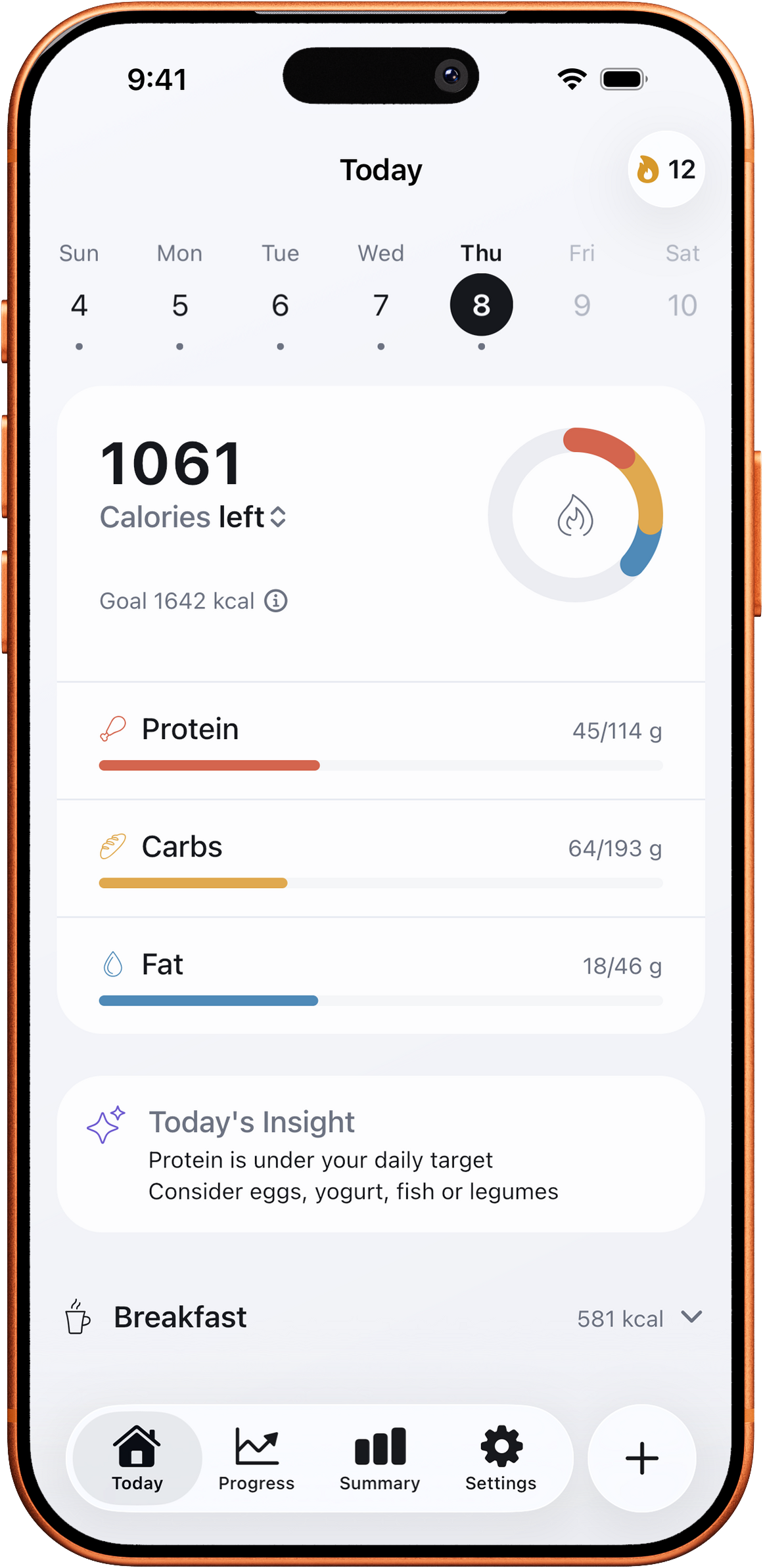
In ClariMeal, scan the barcode, check the serving and set the amount you ate before logging. You can also log a meal by photo or search; a photo is sent for analysis only with your consent, and you review and correct the estimate before logging.
Log Your Packaged FoodLog Your Packaged Food
Sources
- U.S. Food and Drug Administration. How to Understand and Use the Nutrition Facts Label. fda.gov ↑
- U.S. Food and Drug Administration. 21 CFR 101.9, Nutrition labeling of food. law.cornell.edu ↑
- European Union. Regulation (EU) No 1169/2011 on the provision of food information to consumers. eur-lex.europa.eu ↑