Why Is My Weight Going Up in a Calorie Deficit?

The meals were logged and the calorie target was met. This morning the number on the scale is higher anyway, and it is natural to wonder whether the effort makes any difference.
Your weight can rise during a calorie deficit because the scale measures more than body fat. Stored carbohydrate and the water that comes with it change the reading. Food and drink still in your digestive tract count toward the total too. A higher number on one morning does not, by itself, show that your deficit has stopped working.
The useful question is whether your weight shows a steady direction over several weeks. You do not need to change your meals in response to one reading.
Why your weight can change overnight
Stored carbohydrate brings water with it
Your body stores carbohydrate as glycogen, including in the liver and muscles. Glycogen is stored with roughly three to four times its weight in water [1].
When glycogen stores change, that water changes too. Refilling glycogen after a meal with more carbohydrate can raise scale weight without the increase being body fat [1]. This is one reason a change in eating can produce a noticeable change in the reading.

That is part of what people mean by water weight. A single weigh-in cannot tell you how much of a change comes from water.
Food and drink have physical weight
A calorie total describes energy, not the physical weight of a meal. Food and drink still in your digestive tract are included when you step on the scale.
Weighing before breakfast and again after eating and drinking gives two readings with different amounts of food and fluid inside. They are not comparable measurements of body fat.
Weekends can create a repeating pattern
Researchers have observed higher weights around the weekend and the start of the week, followed by lower readings later in the week. The pattern appeared in a study by Orsama and colleagues and in a larger European weight-maintenance study by Turicchi and colleagues [2, 3].
These are group patterns, not a schedule your body must follow, and they do not show that every weekend increase is water. The practical lesson is not to treat a Monday reading that is higher than Friday's as proof of lasting gain.
The menstrual cycle adds context
If you menstruate, cycle timing is worth considering when you read your weight. In a year-long diary study, participants reported the most fluid retention on the first day of menstrual flow [4].
The study measured how people felt, including bloating, not changes on the scale, so it cannot tell you how much your weight should change. It does support paying attention to a repeating cycle pattern instead of assuming that every higher day reflects your eating.
Why weight does not follow calories in a straight line
Daily fluctuations and the body's longer-term response to eating changes are different processes.
Modeling work by Hall and colleagues shows that the body responds gradually to a change in calorie intake, and energy expenditure adapts as body weight changes [5]. So a calorie change does not show up as the same change on the scale each day.
There is another difference: a calorie target is an estimate, while a calorie deficit is the actual gap between the energy you take in and the energy you use. Meeting an estimated target cannot confirm the size of that gap. One higher weigh-in cannot confirm it either.
Four steps for reading your weight more calmly
- Keep weighing conditions similar. If you choose to weigh yourself, use the same scale at a similar time. In the morning, after using the bathroom and before food or drink, in similar clothing, is a practical routine.
- Look across several weeks. If you already have several readings, look at a trend line or weekly averages. Include the higher readings as well as the lower ones. The aim is to understand the pattern, not to pick the most reassuring number.
- Compare similar points in your routine. If you weigh weekly, compare the same weekday. If you notice a menstrual pattern, compare similar stages of your cycle too. This is a way to account for the patterns above, not a test you pass or fail.
- Keep your next meal ordinary. Log the reading if that is part of your routine, then continue with your planned meals. A higher number alone is not a reason to skip food or lower your calorie target.
You can use a notebook, a spreadsheet or an app. Choose a way you can review without checking the day's number again and again.
When to review your calorie target
If the trend has stayed broadly flat for three to four weeks under similar weighing conditions, it makes sense to review the estimate behind your target. This is a point to review, not a deadline by which your body should have changed.
Check whether the profile and activity level used to set the target still describe your routine, along with your portions and entries. The TDEE calculator can help you review the estimate for that profile. The guide to how many calories to eat a day explains how to check a target. Then you can lower the target once, in a small step, without going below 1,200 kcal a day for women or 1,500 kcal for men. These limits are app rules, not numbers to aim for.
If your weight still does not change, do not keep cutting calories on your own. Take your weight and meal records to a doctor or a registered dietitian and review the target together.
If feeling hungry on your plan is the bigger concern, see how to feel full on fewer calories.
Your weight trend in ClariMeal
A higher reading is information, not failure. You do not need to find the exact cause of every change.
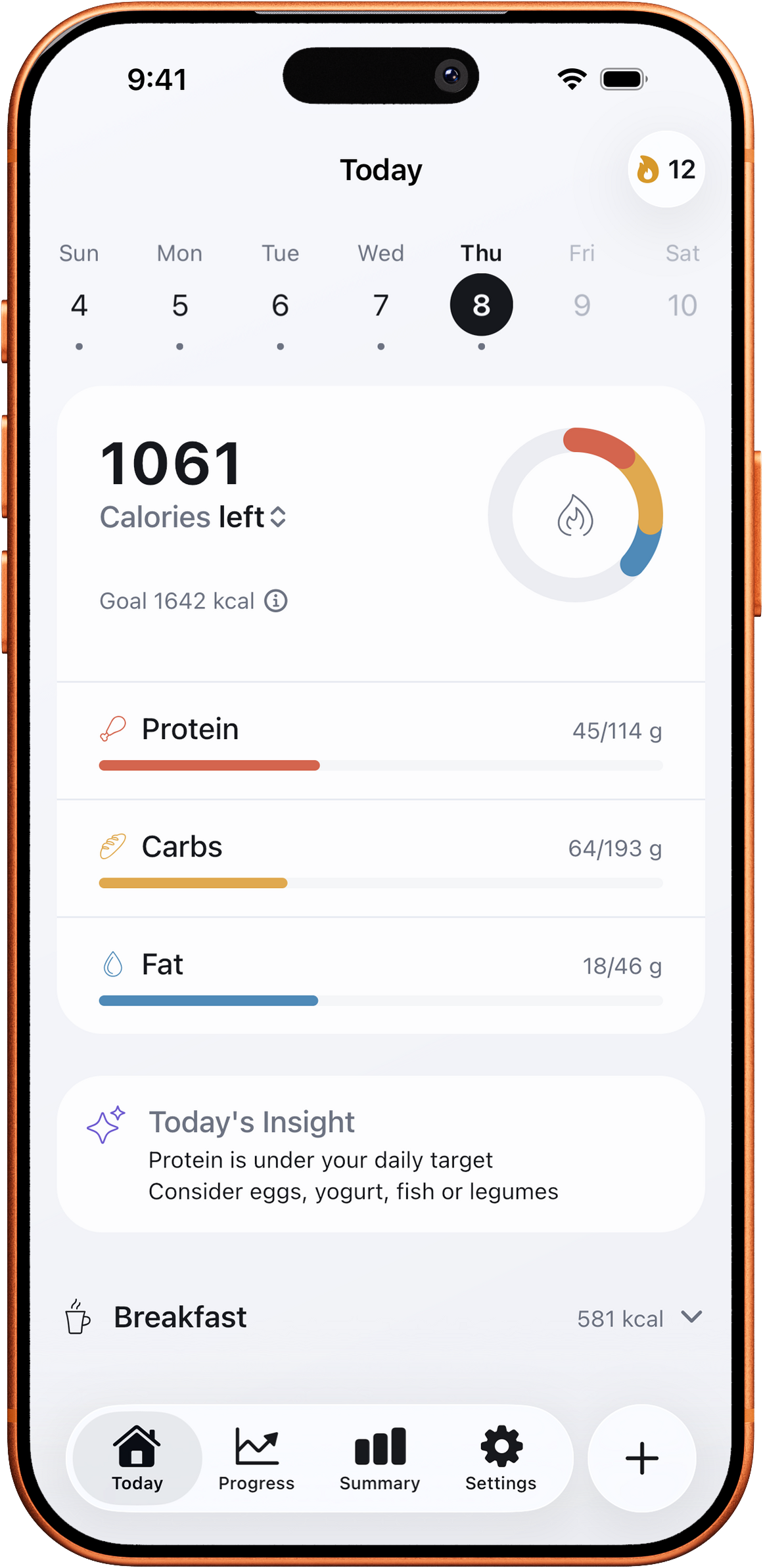
ClariMeal lets you log your weight and see the trend, with the focus on its direction rather than a single daily weigh-in. You can log a meal by photo, search or barcode; a photo is sent for analysis only with your consent, and you review and correct the estimate before logging.
See Your Weight TrendSee Your Weight Trend
Sources
- Kreitzman SN, Coxon AY, Szaz KF. Glycogen storage: illusions of easy weight loss, excessive weight regain, and distortions in estimates of body composition. American Journal of Clinical Nutrition 1992;56(1 Suppl):292S-293S. doi.org/10.1093/ajcn/56.1.292S ↑
- Orsama AL, Mattila E, Ermes M, et al. Weight rhythms: weight increases during weekends and decreases during weekdays. Obesity Facts 2014;7(1):36-47. doi.org/10.1159/000356147 ↑
- Turicchi J, O'Driscoll R, Horgan G, et al. Weekly, seasonal and holiday body weight fluctuation patterns among individuals engaged in a European multi-centre behavioural weight loss maintenance intervention. PLOS ONE 2020;15(4):e0232152. doi.org/10.1371/journal.pone.0232152 ↑
- White CP, Hitchcock CL, Vigna YM, Prior JC. Fluid retention over the menstrual cycle: 1-year data from the prospective ovulation cohort. Obstetrics and Gynecology International 2011;2011:138451. doi.org/10.1155/2011/138451 ↑
- Hall KD, Sacks G, Chandramohan D, et al. Quantification of the effect of energy imbalance on bodyweight. The Lancet 2011;378(9793):826-837. doi.org/10.1016/S0140-6736(11)60812-X ↑