How Many Calories Are in a Pound of Fat?
About 3,500 calories per pound, or about 7,700 per kilogram, is the familiar estimate based on the energy in fat tissue [1]. These are kilocalories, written as kcal.
But weight on the scale includes more than fat. Water and lean tissue change too, and your body's energy use changes as your weight changes. That is why the number does not turn directly into a predictable change on the scale.
If you log your meals and the scale does not match the calculation, it is hard to know whether your target makes sense. Knowing what the rule describes helps you use your target without expecting every weigh-in to follow the math.
Where does the 3,500-calorie number come from?
The rule comes from a calculation that assumed the lost weight was fat tissue made of about 87% fat [1]. Fat tissue also holds water and other components, so a pound of it carries less energy than a pound of pure fat. In food, fat gives 9 kcal per gram; the calories per gram calculator shows how that adds up.
The calculation is usually traced to a 1958 paper by Wishnofsky [2]. In different units, the rule reads:
| Amount | Approximate energy |
|---|---|
| One pound | 3,500 kcal |
| One kilogram | 7,700 kcal (32.2 MJ) |
Both lines describe the same rough rule [1].
Is the 3,500-calorie rule true?
It has a basis in the energy of fat tissue, but it is unreliable for predicting weight loss over time.
The familiar claim is that a 500 kcal daily deficit means a pound lost each week. As a straight-line forecast, this assumes the deficit stays the same and every pound lost has the same energy content. Neither holds for long.
Thomas and colleagues compared the rule's predictions with measured weight loss in seven experiments where food intake was supervised or objectively measured. The rule overestimated the actual weight loss, and models that account for change over time did better [3].
So how many calories does it take to lose a pound? There is no single deficit that predicts a pound on the scale for everyone. The usual number gives rough context, but it cannot tell you what your scale should show on a given day.
Why the scale does not follow the rule
Weight loss includes more than fat
Lost weight includes some lean tissue and water. Lean tissue carries much less energy per pound than fat, and water carries none [1]. For short-term ups and downs, read why weight can go up in a calorie deficit.
Energy use changes with body weight
A smaller body uses less energy at rest and during movement, and energy use also adapts to a change in intake. If you keep eating the same amount, the original deficit gets smaller over time [4].
This is why weight change slows. In one model, the body's weight responded slowly to a lasting change in intake: about half of the eventual change took around a year [4]. A calculation based on your starting energy needs keeps counting a deficit that is no longer the same size.
Starting body composition matters
Hall's model predicts that people with more body fat need a larger deficit per pound lost, because more of their loss is fat. With less body fat, a bigger share of the loss comes from lean tissue, which carries less energy. The 3,500 rule roughly fits people with more than 30 kg of body fat and overestimates the deficit needed for people with less [1].
This is about what the lost weight is made of. The change in energy use is a separate reason why a fixed cut in food does not give a straight-line forecast.
What this means for your calorie target
Use the rule as a rough starting reference, then check it against your records over several weeks:
- Start with an estimated target. The TDEE calculator gives a maintenance estimate and the macro calculator a target for your goal. The guide to how many calories to eat a day explains how to choose and check it.
- Keep a record you can review. Log your meals and weigh yourself under similar conditions, for example in the morning.
- Look at the trend over weeks. Compare the overall direction with your meal records, not one weigh-in.
- Check the inputs before changing anything. If you are aiming to lose weight and your weight has stayed about the same for three to four weeks, first check your portions, your entries and the activity level you chose. Then you can lower the target once, in a small step, without going below 1,200 kcal a day for women or 1,500 kcal for men. If your weight still does not change, do not keep cutting calories on your own; talk to a doctor or a registered dietitian. Changing the target again and again to match a calculated schedule does not make the estimate more accurate.
The aim is to understand your own pattern well enough to make a calm decision.
How ClariMeal uses the number
For a goal of losing or gaining weight, ClariMeal turns a weekly pace into daily calories using 7,700 kcal per kg of weight change, and calories do not go below 1,200 kcal a day for women or 1,500 for men. These are app rules and a starting estimate, not a prediction. The calculation is described on the macro calculator page.
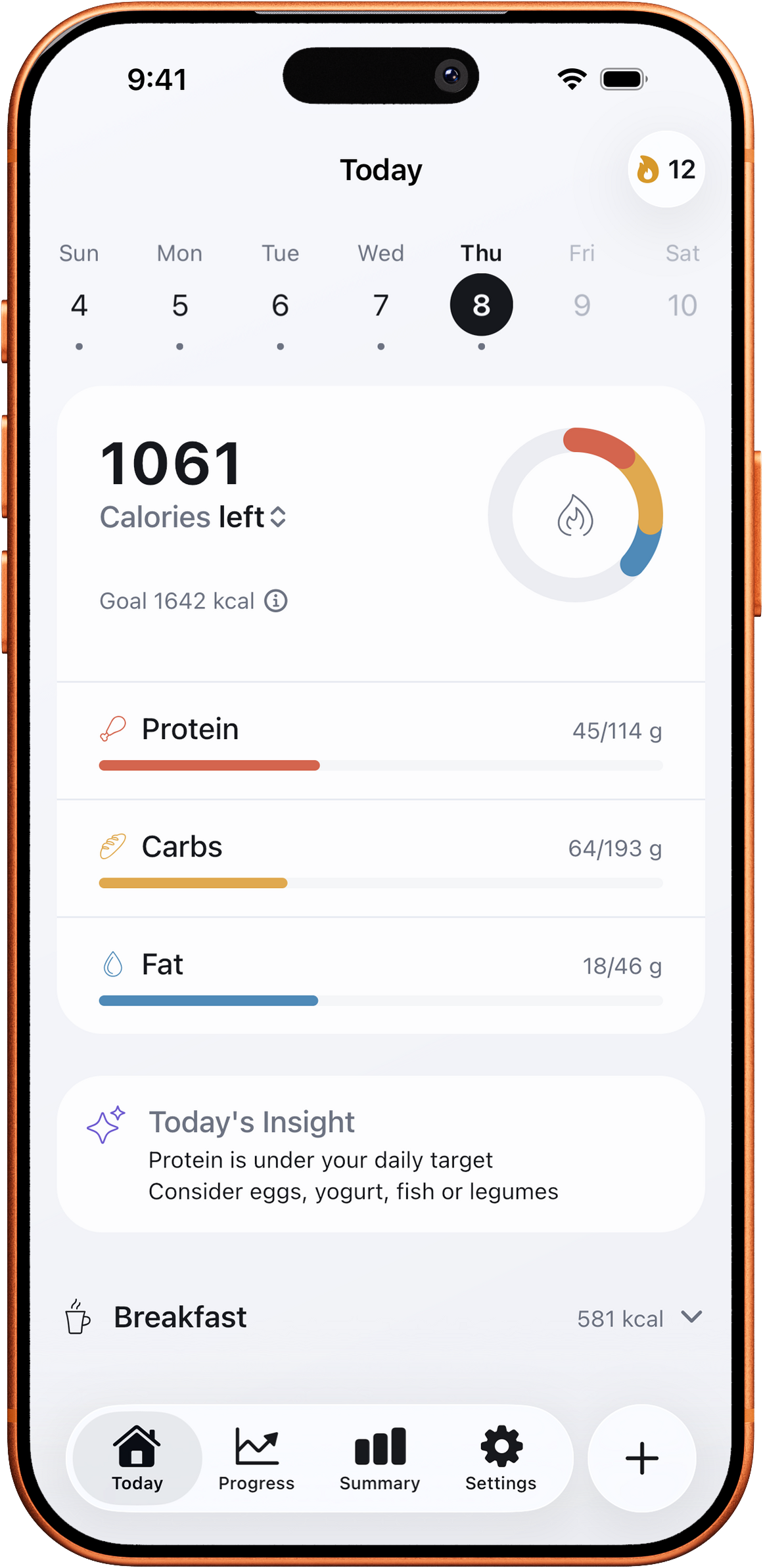
The Today screen shows your logged calories and macros against your targets, and Progress shows your weight trend over time, so you can compare the two. You can log a meal by photo, search or barcode; a photo is sent for analysis only with your consent, and you review and correct the estimate before logging.
See Your Weight TrendSee Your Weight Trend
Sources
- Hall KD. What is the required energy deficit per unit weight loss? International Journal of Obesity 2008;32(3):573-576. doi.org/10.1038/sj.ijo.0803720 ↑
- Wishnofsky M. Caloric equivalents of gained or lost weight. American Journal of Clinical Nutrition 1958;6(5):542-546. doi.org/10.1093/ajcn/6.5.542 ↑
- Thomas DM, Martin CK, Lettieri S, et al. Can a weight loss of one pound a week be achieved with a 3500-kcal deficit? Commentary on a commonly accepted rule. International Journal of Obesity 2013;37(12):1611-1613. doi.org/10.1038/ijo.2013.51 ↑
- Hall KD, Sacks G, Chandramohan D, et al. Quantification of the effect of energy imbalance on bodyweight. The Lancet 2011;378(9793):826-837. doi.org/10.1016/S0140-6736(11)60812-X ↑